
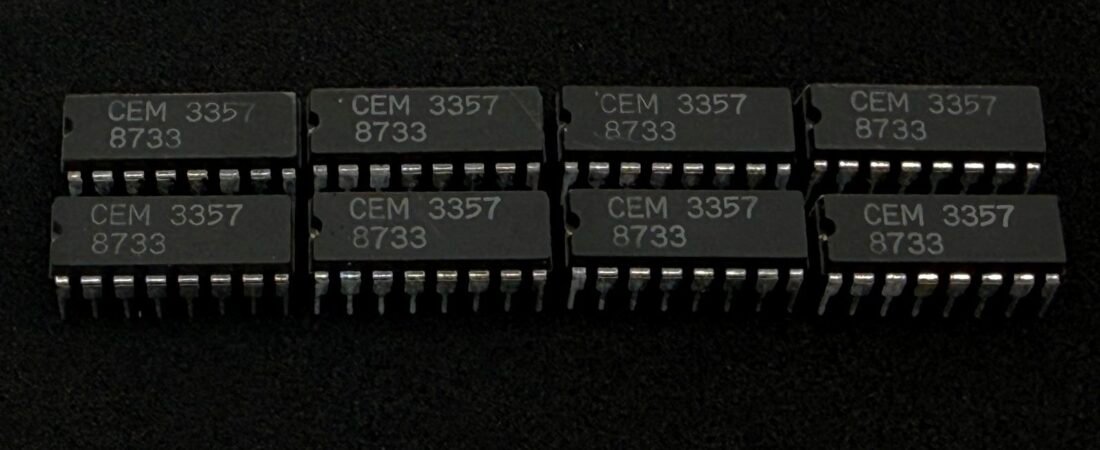
I got my hands on a big lot of CEM3357 sample & hold chips from Curtis Electromusic. I have most Curtis datasheets but this one is really elusive.
What do I know about it?
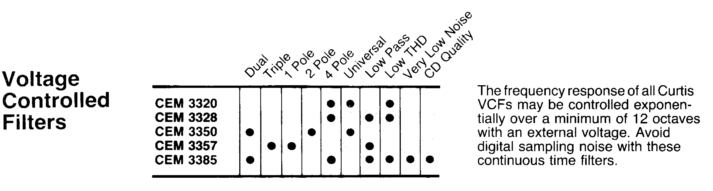
A 4 page leaflet from Curtis shows CEM3357 as being a triple one pole low pass filter. It clearly is a mistake!
CEM3357 is a 16 pin DIP integrated circuit. It is a Sample and Hold with 3 channels and was used in Sequential Circuits Prophet 3000 sampler from 1987. In fact, the service manual of the Prophet 3000 was the only source of information that I ever found.
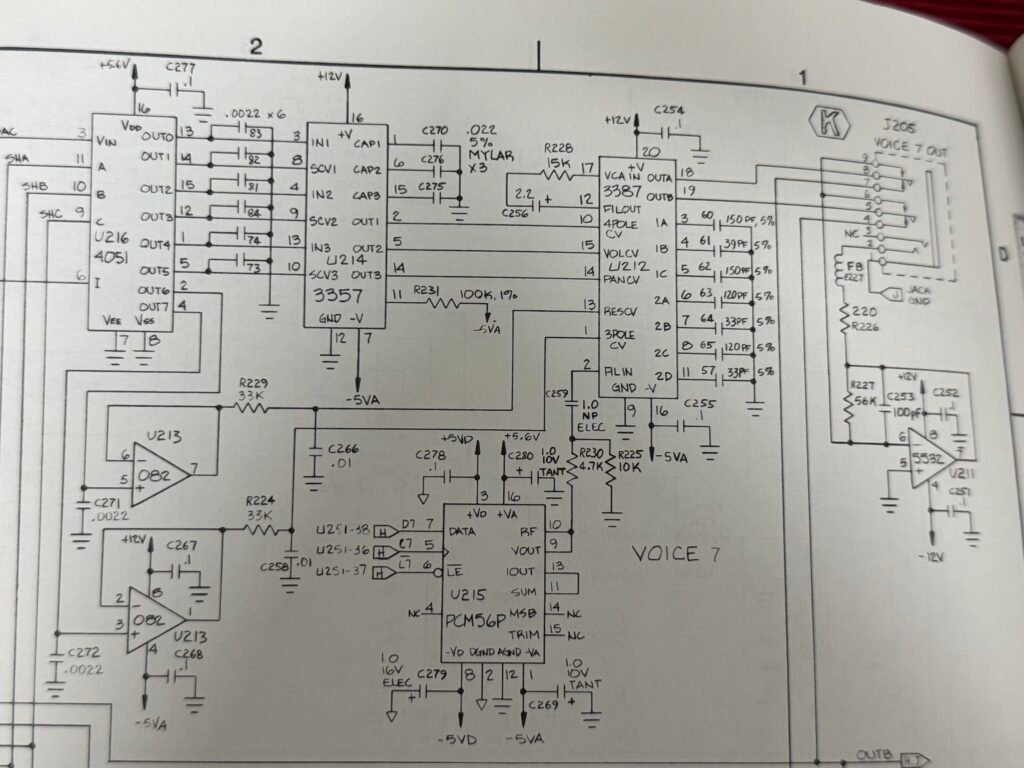
So, here is the pinout of CEM3357:
| Pin | Function |
|---|---|
| 1 | CAP1 |
| 2 | OUT1 |
| 3 | IN1 |
| 4 | IN2 |
| 5 | OUT2 |
| 6 | CAP2 |
| 7 | −V (−5V) |
| 8 | SCV1 |
| 9 | SCV2 |
| 10 | SCV3 |
| 11 | Bias / IREF (?) |
| 12 | GND |
| 13 | IN3 |
| 14 | OUT3 |
| 15 | CAP3 |
| 16 | +V (+12V) |
Pin 11 Function (Inferred)
The exact function of pin 11 of the CEM3357 is not documented in any publicly available Curtis Electromusic documentation. However, analysis of the Prophet 3000 schematic strongly suggests that this pin is used as an internal bias-current programming input.
In the Prophet 3000 implementation, pin 11 is connected exclusively to the −5VA analog supply rail through a precision 100k 1% resistor. The pin is not connected to any signal path, timing capacitor, logic line, or external control circuitry.
This configuration is characteristic of many precision analog integrated circuits from the 1980s, particularly Curtis and other custom analog ASIC designs, where an external resistor establishes a small reference current used internally by the chip.
The resulting current is approximately:
This reference current was likely used internally for one or more of the following functions:
- Biasing the analog output buffer amplifiers
- Setting analog switch operating current
- Leakage-current compensation
- Charge-injection optimization
- Internal tracking/hold stabilization
Because the CEM3357 is used as a precision triple sample-and-hold device in the Prophet 3000 voice circuitry, low leakage and stable long-term hold performance would have been essential design goals.
Although the exact internal implementation remains unknown, the schematic evidence strongly supports the conclusion that pin 11 is a bias/reference current programming node rather than an audio, logic, or control input.
One subtle but important observation:
The hold capacitors (CAP1 – 3) are 5% Mylar film capacitors – not electrolytic and not ceramic. That choice was deliberate in order to obtain low leakage, low dielectric absorption and stable long-term CV storage which tells us that Sequential cared about droop and tuning stability.