Description
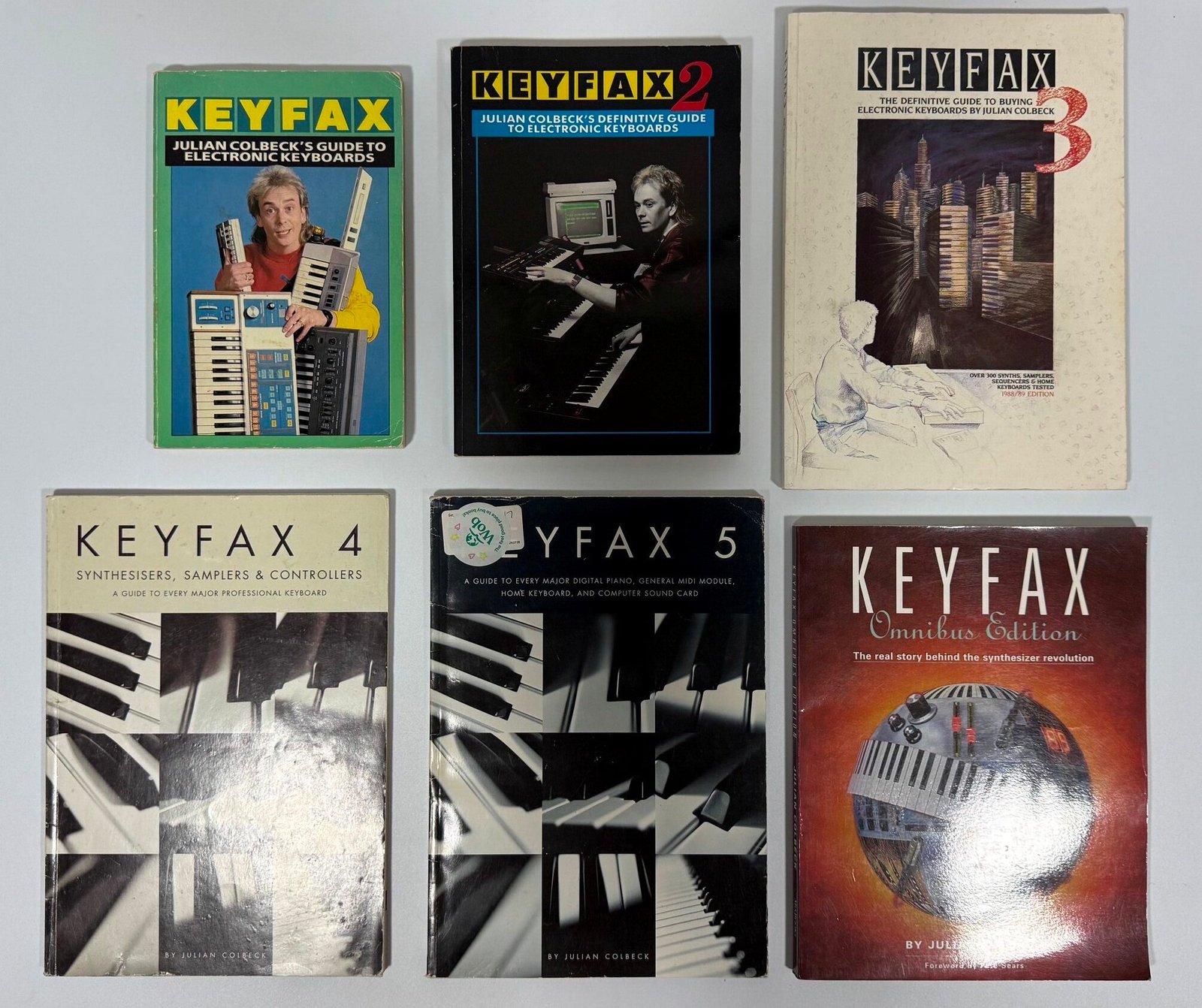
There is a particular pleasure in completing a set of books that were never really meant to become collectibles. They were meant to be used. Thumbed through. Argued with. Kept near a studio desk. Consulted before buying a synth, selling one, or trying to understand why one grey plastic box from 1986 felt strangely more alive than another. That is part of the charm of Julian Colbeck’s Keyfax books: they sit somewhere between buyer’s guide, field report, keyboard encyclopedia, and love letter to the electronic instrument boom.
Looking at all six together – Keyfax 1 through Keyfax 5, plus the later Omnibus Edition – you are not just looking at a run of reference books. You are looking at a map of a fast-moving era when synthesizers, samplers, MIDI modules, home keyboards, workstations, and computer-based music systems were changing almost yearly. The covers alone tell the story: monochrome close-ups of keys and sliders; bold late-1980s design; that unmistakable mixture of optimism, utility, and slight techno-mysticism that surrounded electronic keyboards at the time.
And behind it all is Julian Colbeck, a writer who understood these instruments not only as specifications, but as musical tools.
Julian Colbeck: Player, Writer, Witness
Julian Colbeck was well placed to write about keyboards because he was not approaching them as an outsider. He was a professional keyboard player for over a decade, with credits including work with Yes/ABWH, Steve Hackett, John Miles, and his own band Charlie. He later became known as an author, music-technology journalist, producer of instructional media, and CEO of Keyfax NewMedia.
That combination matters. The Keyfax books are not dry catalogues in the way many equipment directories can be. Colbeck was writing from the working musician’s point of view. He knew that a keyboard was not just a list of oscillators, filters, polyphony, memory slots, or MIDI implementation charts. It was something that had to sit under the hands. It had to earn its place on stage or in the studio. It had to inspire, or at least behave.
That is one reason these books still have character. They are full of the practical curiosity of someone trying to understand what an instrument actually does for a musician. The tone is informative but not sterile. Even when the format is that of a guide, there is personality in the selection, the emphasis, and the occasional judgment.
What Keyfax Captured
The Keyfax series began in the mid-1980s, with Keyfax 1 appearing in 1985 and Keyfax 2 in the following year. A later listing describes Keyfax 2 as Colbeck’s “definitive guide to electronic keyboards,” covering instruments from the Gleeman Pentaphonic to the Kinetic Prism and Roland Super JX.
That range is important. These were not books only about the obvious classics. Yes, the great names are there – Yamaha, Roland, Korg, Sequential, Moog, Oberheim, Ensoniq, E-mu, Akai, Kurzweil and the rest – but part of the appeal is the breadth. The books caught instruments that might otherwise have slipped through the cracks: transitional machines, oddball digital synths, short-lived samplers, ambitious controllers, and keyboards that were once simply “current products” but are now historical artifacts.
In the 1980s and 1990s, the keyboard world was in a state of permanent acceleration. Analogue polysynths had given way to digital FM, sampling, wavetable synthesis, LA synthesis, sample-and-synthesis hybrids, ROMplers, workstations, MIDI modules, and eventually computer-integrated production. Every year seemed to bring a new flagship and a new promise: more realistic sounds, more memory, more voices, more multitimbrality, more sequencing power, more control.
The Keyfax books documented that movement as it was happening. That gives them a quality that later histories cannot quite reproduce. They are not retrospective accounts written after the winners and losers were known. They are snapshots from inside the storm.
More Than Specifications
The genius of a good reference book is not simply that it contains facts. It is that it arranges them in a way that reveals a world.
The Keyfax format made keyboards comparable. A reader could move from one instrument to another, weighing features, reputations, strengths, weaknesses, and intended users. At a time before YouTube demos, online forums, searchable manuals, Reverb listings, and endless comparison videos, this kind of book was valuable in a very immediate way. It helped musicians make decisions.
But now, decades later, its value has shifted. The books have become cultural documents. They show how instruments were perceived in their own moment. They preserve the language of the period: “professional keyboard,” “home keyboard,” “digital piano,” “MIDI module,” “sound card,” “sampler,” “workstation.” They remind us how porous the borders were between consumer electronics, professional studio equipment, and experimental electronic music.
To read Keyfax today is to be reminded that many instruments we now call “vintage” were once evaluated as practical purchases. Some were expensive dreams. Some were compromises. Some were future classics hiding in plain sight.
The Omnibus Edition
The later Keyfax Omnibus Edition drew the story together. Published by Mixbooks in 1996 as part of the Mix Pro Audio Series, it ran to just under 200 pages and compiled a broad history of synthesizers up to that point. One retrospective description calls it one of the few encyclopedia-like works dedicated to synthesizers, noting its coverage of the “HOT 100” instruments, manufacturer background, and compact technical “fax data” such as synthesis type, dimensions, weight, production period, and production numbers.
The Omnibus is especially interesting because of its timing. By 1996, the first great age of hardware synth mythology had already happened, but the second-hand market had not yet become the obsessive online ecosystem it is today. Analogue instruments were beginning to be reassessed, digital classics were starting to gain their own identities, and computer music was becoming central. The book therefore lands at a fascinating midpoint: late enough to look back, but early enough still to feel connected to the original wave.
It is not perfect, and that is part of its charm. Specialist synth historians may quibble with details, and some information has inevitably been corrected or expanded by later research. But the Omnibus has the authority of a work made close to the culture it describes. It feels less like a museum label and more like a well-informed musician taking you around a very crowded room and saying: this one mattered, this one was strange, this one changed things, this one you should not overlook.
Why Owning the Full Set Feels Special
Completing the five-book run plus the Omnibus Edition feels meaningful because the set represents more than a bibliography. It represents continuity. Each volume belongs to a period when electronic keyboards were evolving at a speed that made printed guides both necessary and instantly vulnerable to obsolescence.
That is the paradox of books like these. They were written to be current, and then time turned them into history.
Today, the Keyfax books invite a slower kind of reading. You can browse them as reference works, but also as archaeology. A page on a once-new synth now carries several layers of meaning: what the manufacturer promised, what the reviewer noticed, what musicians might have needed at the time, and what history later decided. The books preserve not only machines, but expectations.
For anyone interested in synthesizers, that is priceless. Instruments are not only circuits, samples, chips, wooden cheeks, membrane buttons, or MIDI ports. They are also stories of use: who bought them, who wanted them, who dismissed them, who made records with them, who rediscovered them twenty years later. Colbeck’s Keyfax books are part of that story.
A Shelf of Electronic Music History
Julian Colbeck’s achievement with Keyfax was to take a chaotic, rapidly expanding field and make it legible. He gave musicians a way to compare, understand, and dream about electronic keyboards at a time when the landscape was exploding. The books were practical, but they were also quietly enthusiastic. They treated keyboards as serious musical instruments while still acknowledging the excitement of new technology.
Seen together now, Keyfax 1 to Keyfax 5 and the Omnibus Edition form a compact history of a revolution: the moment when electronic keyboards moved from specialist instruments to the center of pop, rock, studio production, home recording, and eventually computer-based music.
For a collector, completing the set is satisfying. For a synth enthusiast, it is a treasure. For anyone who cares about the history of electronic music, it is a reminder that revolutions are often documented first not in grand histories, but in practical guides – the books people bought because they needed to know what all these wonderful, confusing machines actually did.

Reviews
There are no reviews yet.